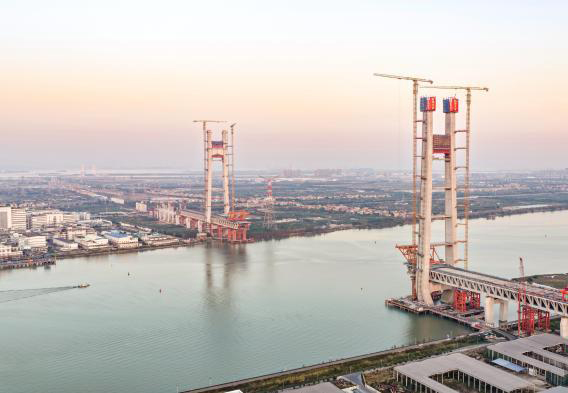
On January 11, the main tower of Pier 50 of the Hongqili Waterway Road-Rail Bridge on the Shenzhen-Jiangmen Railway was successfully capped, reaching a height of 258 meters, equivalent to the height of a building of more than 80 stories. With this, both main towers of this key transportation project in the Guangdong-Hong Kong-Macao Greater Bay Area have been capped, marking a major milestone breakthrough in the construction of the Shenzhen-Jiangmen Railway and its entry into the stage of mid-span main girder erection and stay cable installation.
The newly built Shenzhen-Jiangmen Railway is a high-speed railway within Guangdong Province running from Shenzhen to Jiangmen. The line starts at the newly built Shenzhen Xili Station, runs westward through Dongguan, Guangzhou, Zhongshan and Jiangmen, and connects to Jiangmen Railway Station, with a main line length of approximately 116 kilometers.
The Hongqili Waterway Road-Rail Bridge is constructed and managed by Xiamen-Shenzhen Railway Guangdong Co., Ltd., designed by China Railway Siyuan Survey and Design Group, and built by China Railway Major Bridge Engineering Group. It is one of the controlling projects of the entire Shenzhen-Jiangmen Railway. The bridge adopts a double-tower, double-cable-plane semi-floating system, and its construction difficulty and technical content rank among the top of similar projects. The main bridge of the joint-construction section is 1.411 kilometers long with a main span of 808 meters, innovatively adopting a new structural system—the world's first road-rail joint-construction cable-stayed bridge with ultra-short side spans and steel-concrete box-truss composite girders. The upper deck carries an eight-lane urban expressway, while the lower deck carries a four-track high-speed railway, achieving efficient integration of road and rail traffic.
During the foundation construction stage, to address the challenge of forming the 4-meter super-large-diameter bored piles for the main piers, a combined construction scheme using the self-developed "KTY5000 rotary drill" of China Railway Major Bridge Engineering Group together with a rotary drilling rig was adopted, giving full play to the advantages of different rigs under different geological conditions and greatly improving hole-forming quality and construction efficiency. This not only achieved a fast hole-forming rate of as little as 7 days per pile, but also completed the construction of 70 4-meter piles for the two main piers with high quality within 100 days.
Both main towers of the bridge, Piers 49 and 50, adopt an "H"-shaped design. The tower bodies use C60 high-strength concrete and were poured in 47 construction segments. Facing complex construction challenges, the construction team relied on independent innovation and technical research to overcome a series of engineering difficulties.
Considering the stringent requirements on concrete performance in the coastal environment, the project team, relying on the National Key Laboratory of Bridge Intelligent and Green Construction, continuously optimized the construction scheme and innovatively adopted a dual-blending technology of "fly ash + mineral powder" together with a high-performance water reducer, significantly improving the workability and crack resistance of the C60 concrete. At the same time, through the integrated application of a series of advanced technologies and processes—including strict quality control of raw materials, intelligent production at the concrete mixing plant, ultra-high-pressure single-pump top pouring, and refined curing—the project ensured that the main tower concrete structure met the quality benchmark of "solid inside and smooth outside, uniform color, and straight lines."
As an important part of the coastal corridor of the national "Eight Vertical and Eight Horizontal" high-speed railway main network, the bridge, once completed, will enable half-hour high-speed rail connectivity between Shenzhen Qianhai and Guangzhou Nansha and one-hour direct travel between Shenzhen and Jiangmen, greatly promoting the integrated development of the east and west banks of the Pearl River Estuary, driving the coordinated development of eastern Guangdong, western Guangdong and the Pearl River Delta region, and providing core support for the Greater Bay Area to build a "city cluster on rails."




评论 (0)