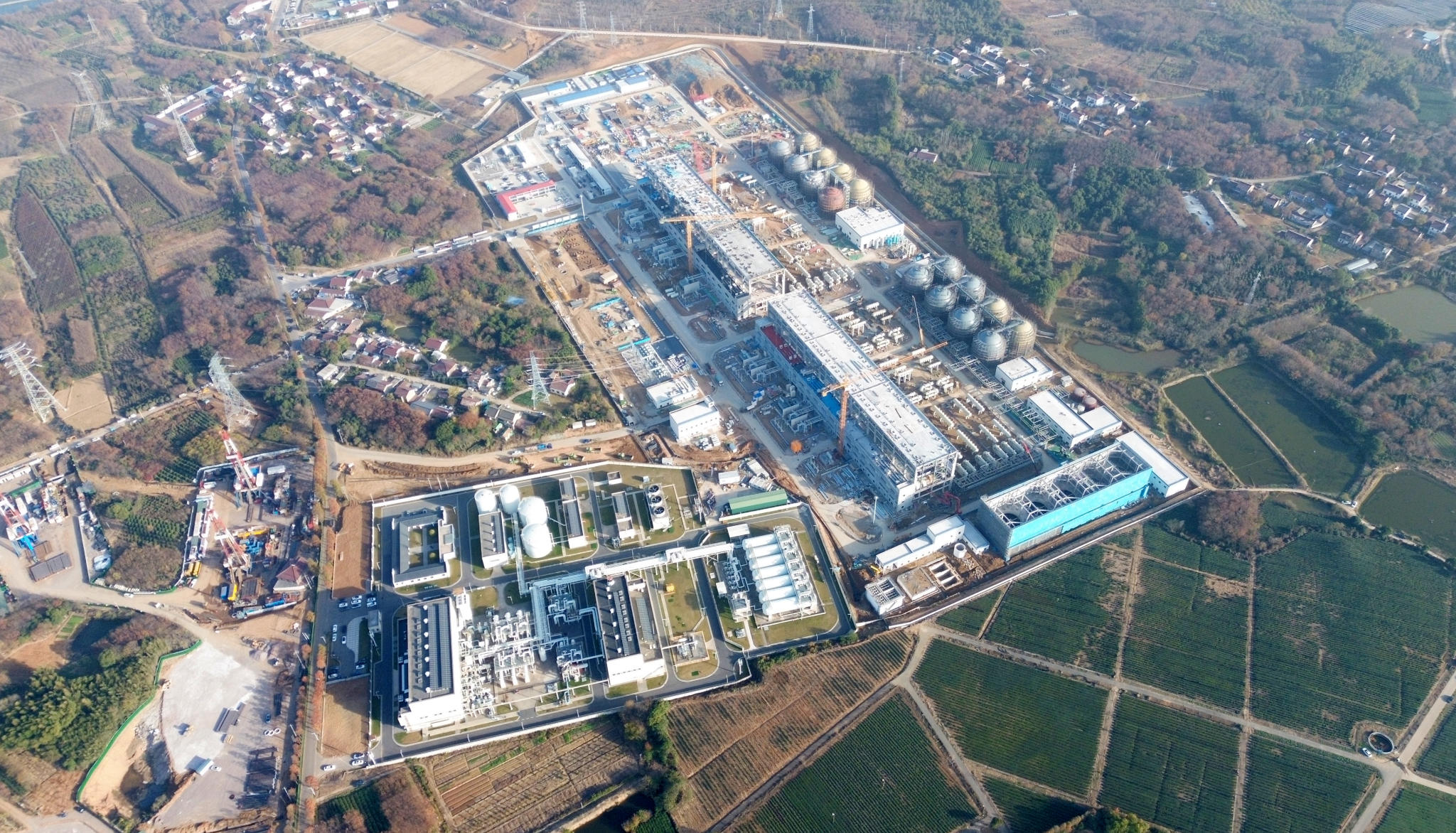
Recently, the No. 2 unit of the Huaneng Jintan 2×350 MW Salt Cavern Compressed Air Energy Storage Power Generation Phase II Project, undertaken by SEPCO1 (Shandong Electric Power Construction No. 1 Company), successfully achieved milestone nodes including the main powerhouse roof capping and water cutoff, a one-time success in DCS power-on, and the hoisting and positioning of the first compressor motor.
The Huaneng Jintan project team of SEPCO1 has seized the golden construction period, scientifically coordinated various resources, optimized construction procedures and technical plans based on project planning and execution as well as equipment delivery status, strengthened safety, quality and schedule management throughout the entire process, carried out process control and acceptance work, and driven high-quality project delivery. At present, 80% of the transformer installation for the No. 2 unit of the project has been completed, more than half of the heat exchangers have been hoisted and positioned, and main equipment modules such as the air compressor unit and turbine generator unit have successively entered the site and been positioned. On-site installation work is in full swing, propelling the construction of this world's largest salt cavern compressed air energy storage power station onto the "fast track."
It is reported that the Huaneng Jintan Salt Cavern Compressed Air Energy Storage Power Generation Phase II Project plans to build two 350 MW non-supplementary-fired compressed air energy storage units, with a total salt cavern gas storage volume of 1.2 million cubic meters. Compared with traditional compressed air energy storage equipment, the core breakthrough of this energy storage unit lies in the rapid and frequent start-stop technology of multi-reheat and multi-cylinder expander components, which can achieve minute-level response speed and flexibly meet the peak-shaving needs of the power grid.
After the project is completed, it will become the salt cavern compressed air energy storage power station with the largest single-unit power, largest total capacity and highest comprehensive efficiency in the world. It is expected to charge and discharge 330 times per year, and a single charge can store 2.8 million kWh of electricity, enough to meet the charging needs of 100,000 new energy vehicles. It can save 270,000 tons of standard coal and reduce carbon dioxide emissions by 520,000 tons annually, effectively enhancing the power grid's regulation capacity and new energy consumption capacity, and providing core support for building a new-type power system in the Yangtze River Delta region.




评论 (0)