Amsterdam, Netherlands — The Dutch capital Amsterdam has nearly 920,000 residents, making it the most populous city in the Netherlands. On the list of the largest cities in the European Union, Amsterdam ranks 17th. The number of residents is growing steadily, with approximately 1.5 million people currently living in the metropolitan area. To manage the ever-increasing traffic volume caused by urban expansion, the Directorate-General for Public Works and Water Management (Rijkswaterstaat) of the Dutch Ministry of Infrastructure and Water Management has launched various infrastructure projects.
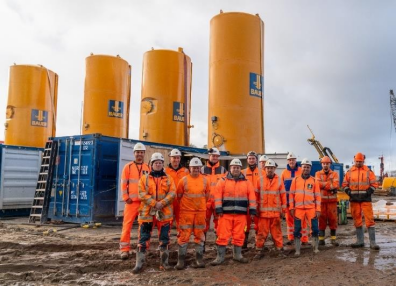
One of the most important projects is the large-scale road construction project "Schiphol-Amsterdam-Almere Corridor". Among other tasks, it includes the expansion of the A9 motorway between Amsterdam Schiphol Airport, Amsterdam South, and the Almere community in the east of the city. In a total of six construction phases, the existing three lanes will be expanded to four lanes in each direction. In addition, all road connections must be widened, new interconnections with slip roads must be established, and new bridges and tunnels must be built.
Between the towns of Badhoevedorp and Holendrecht lies the sixth and final construction section, 11.4 kilometers long, with the Spanish company FCC as the general contractor; FCC subcontracted the anchor pile construction to the joint venture Fundringscombinatie GEWIX Limited Partnership, composed of BAUER Fundringstechnik B.V., the Dutch subsidiary of Bauer Spezialtiefbau GmbH, and De Vries Titan B.V.
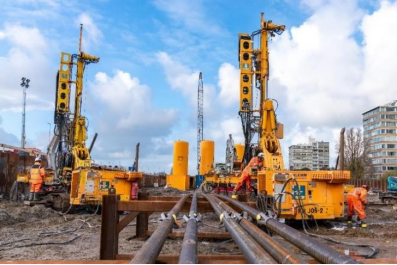
In this work, a section of approximately 1.7 kilometers deserves special attention, as it is gradually being developed into three areas. The middle section of northern and southern Amstelveen (known as the "deep road cutting") will be secured using a total of approximately 12,000 anchor piles, with an average drilling depth of 33 meters. The work began in June 2023 and is scheduled for completion in 2025. In the first of the three construction phases, work is currently underway on the north side of the existing motorway. Maarten Daalmeijer, Project Manager at BAUER Fundringstechnik B.V., said: "The limited workspace within the city and alongside the motorway is a particular challenge. All work must be coordinated so that the existing six lanes remain unobstructed." In addition, the impact on the urban environment must be minimized. Another important challenge is installing the anchor piles at a high groundwater level. This is because Amstelveen is located approximately 2 to 5 meters below NAP (sea level).
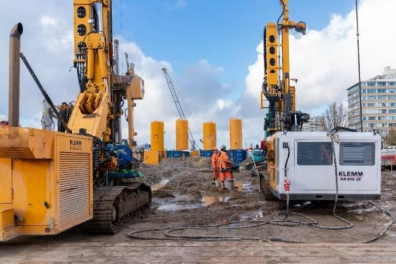
A particular highlight of the project: the newly developed electric KR 806-3E drilling rig from Bauer-Klemm is being used alongside conventional rigs for the first time. This innovative development is equipped with a battery and grid connection. Maarten Daalmeijer continued: "We have already completed a full work phase, including drilling and expansion using entirely the battery's energy reserves; unloading, driving, and transfer operations were also carried out autonomously." Another commendable point: the new equipment operates very quietly, marking another crucial step forward in the field of electric drives for construction equipment.
Latest Progress on Bijie Urban Waterlogging Prevention and Control Project
下一篇Bauer BCS125 Trench Cutter Achieves 9 Months of Continuous High-Efficiency Operation, Helping the Guanghua Intercity Huacheng Street Station Diaphragm Wall Project Complete Successfully
2025-10-11 12786 0
2025-10-11 12335 0
2025-10-11 12499 0

2025-09-11 12043 0



评论 (0)