On November 21, a reporter learned from State Grid Sichuan Electric Power Company that in the ten years since the Sichuan-Tibet power grid interconnection project was completed and put into operation, the Sichuan power grid and the Tibet power grid have transmitted a total of approximately 8.7 billion kWh of electricity to each other in both directions, of which Sichuan transmitted 3.08 billion kWh to Tibet and Tibet transmitted 5.64 billion kWh to Sichuan. The project has not only resolved the electricity supply difficulties in Qamdo, Tibet and the southern part of Garze, Sichuan, but also transmits clean hydropower from both banks of the Jinsha River to load centers such as Chengdu, playing an important role in promoting the consumption of clean energy and local economic and social development.
The Sichuan-Tibet power grid interconnection project is a major construction project supported by the state for Tibet during the 12th Five-Year Plan period. It connects the Sichuan power grid and the Tibet power grid via 500 kV transmission lines, with a total investment of 6.63 billion yuan. The project starts in the east at Xiangcheng County, Garze Prefecture, Sichuan, passes through Batang County, and extends west to Qamdo City, Tibet, with a total length of 1,521 kilometers.
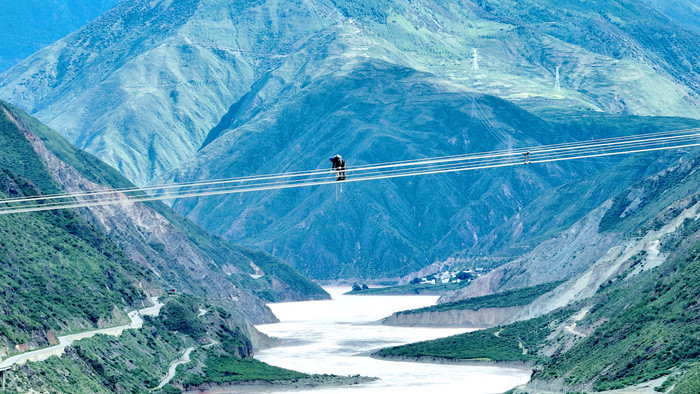 At the site of the annual maintenance of the Sichuan-Tibet interconnection, power workers are walking along the lines for inspection. Photo by Li Chenmeng
Ten years ago, more than 40 participating construction units of State Grid and over 20,000 builders overcame difficulties and obstacles such as towering mountains and steep ridges, separation by rivers, and high-altitude hypoxia to complete the Sichuan-Tibet power grid interconnection project, setting a new record for power grid construction in high-altitude areas of the world. The commissioning of this power transmission and transformation project, which was hailed at the time as the most construction-challenging in the world, ended the history of long-term isolated grid operation of the power grid in the Qamdo region of Tibet.
"Before the Sichuan-Tibet power grid interconnection project was put into operation, my family could only use 25-watt light bulbs, and the power went out from time to time. Now, every household in the village is brightly lit, and agricultural and sideline products such as matsutake mushrooms picked each year can be kept fresh in refrigerators. Electrical equipment is used for production and daily life, which is very convenient." Wen Xianglin, a villager from Xiaqiong Town, Batang County, Garze Prefecture, witnessed the completion and commissioning of the Sichuan-Tibet interconnection project. He said that over the past decade, local infrastructure conditions such as electricity, communications, and transportation have improved steadily, and his family has also set up the village's e-commerce logistics service point.
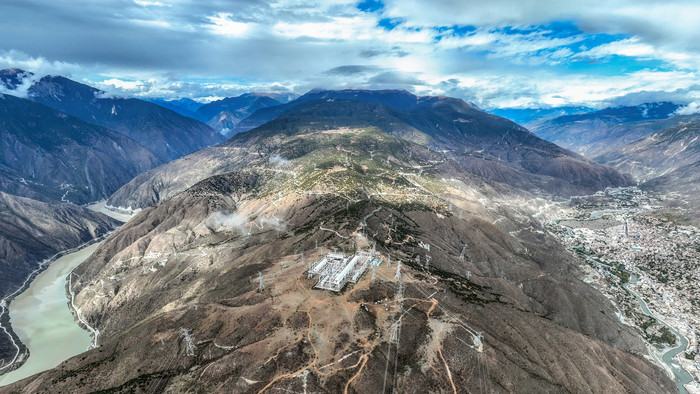 At the border between Batang, Sichuan and Mangkang, Tibet, the Sichuan-Tibet interconnection transmission lines cross the Jinsha River Grand Canyon. Photo by Liu Xiangfan
Over the past decade, the Sichuan-Tibet interconnection project has undergone five major upgrade constructions, and the grid structure has become increasingly robust—
In 2018, the voltage upgrade and expansion project of the Batang 500 kV substation was completed, and the voltage level of the Sichuan-Tibet interconnection project was raised from 220 kV to 500 kV, realizing interconnection between the Sichuan-Tibet interconnection project and the Central Tibet interconnection project and marking Tibet's power grid's entry into the ultra-high voltage era. In 2022, the 500 kV transmission project of the Suwalong Hydropower Station was completed and put into operation, and the first million-kilowatt-level power station in Tibet was commissioned to generate electricity, greatly enhancing the capacity to transmit clean energy from the upper reaches of the Jinsha River. In 2023, the Batang-Lancang River 500 kV line was put into operation, officially forming the third channel of the Sichuan-Tibet interconnection.
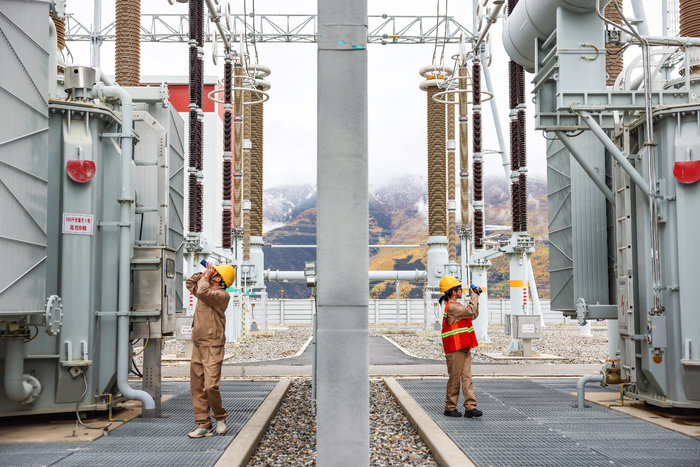 O&M personnel carry out inspection and maintenance work on the interval equipment of the 500 kV Tangmang II line. Photo by Li Wei
At present, the Upper Jinsha River-Hubei ±800 kV ultra-high voltage direct current transmission project and its supporting projects are being accelerated, further promoting the construction of a west-to-east power transmission grid with the ultra-high voltage grid as the main framework and interconnected AC-DC regional networks, serving the high-quality economic and social development of Sichuan and Tibet and helping to achieve optimized allocation of clean energy over a wider range.




评论 (0)